 moe thinks
On the shortcomings of the current OSINT culture and OSINT’s real potential
Well, I’ve always had an issue when it came to finding what I actually want to do in life. On one hand, I’m good at many things, a jack of all trades; on the other hand, the second part of the proverb always haunted me, “master of none,” which wasn’t true for me, actually, but it took me time and effort to realize that.
In any case, this was before I understood my own cognitive profile, which is something along the lines of a “mechanistic multi-axial thinker with low social heuristics and high ambiguity tolerance”.
Which kind of explained the issue to me, but didn’t solve the main issue, of what to do with myself? Along the years, I’ve done many things, I worked as a DevOps engineer, pure self-taught, relying on talent and Google, and I did pretty well, However, I’ve always thought of myself as a writer and well, I ghostwritten doctoral theses, many articles, four or five white papers, countless ghostwritten research papers, and I even worked with celebrity professors and Trust me, you’ve probably read a few quotes that were attributed to them but actually were written by me (this always bugged me, I won’t lie).
Meanwhile, I’ve always worked as a reverse recruiter, I only regret not coined the term, since I was there, among the first who actually done this professionally, but I never actually thought of coining the term.
I always went the extra mile, I always used my research skills to enhance the chances of my clients and this was also before the term OSINT was so widespread. I was doing OSINT but I never cared about naming what I was doing. I dare say that I perfected the practice to an art form where I can give my clients a very accurate representation of a job market and the internal workings of a company, without ever breaking laws or doing any illegal penetration. The signs are always there, and the gossip is always available if you know where to look. You don’t even need group chats when Facebook groups exist.
Anyway, back to OSINT, let’s get down to the basics, and then we can move on to where I see much room for improvement.
OSINT is usually described as collecting and analyzing available information publicly to answer a specific question. That sounds broad, but in day-to-day practice, OSINT often gets reduced to a narrow performance: finding a person, proving a hunch, or “solving” a puzzle fast enough to look impressive.
And people who go into OSINT can be categorized into two broad categories (with caveats, but allow me to generalize for argument’s sake, I actually do not fall in either of those categories)
Category 1: Cybersecurity professionals who either do this for extra income and find this trivial compared to their skill-set, and some of those work for security apparatuses and have to do it because one: its needed and two: they’re forced to do it by their bosses.
Category 2: Amateurs who watched Sherlock, Elementary, and/or Mr Robot, and now they have fantasies of being genius internet detectives and claiming those sweet, sweet "Rewards For Justice’ bounties. I mean,can you imagine the clout? (Personally, I’d argue that having a bounty put on you as a hacker -not a terrorist, obviously- gives more clout, but that’s just me).
Anyway, this leads to the claim I make in this article: OSINT’s biggest limitation today is not access to data or a lack of tools. It is the framing.
In other words, OSINT is used for investigative discovery, when its most fruitful use, I would argue, is in decision making support.
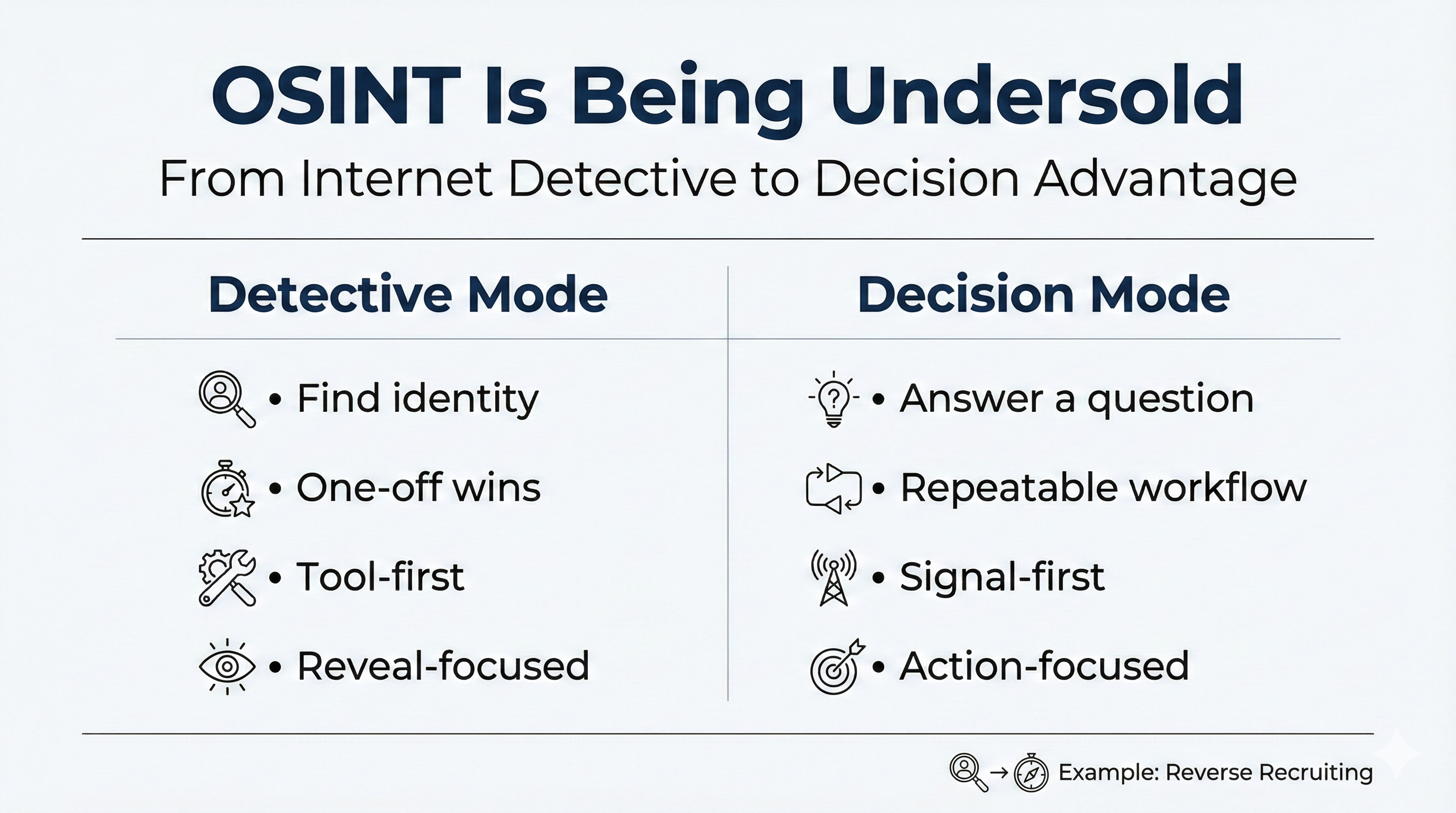
When OSINT is treated as detective work, the “win” is discovery. When OSINT is treated as decision support, the “win” is making the right move sooner, with higher confidence, and with fewer wasted resources and opportunities.
The detective mindset that caps results
Online OSINT culture trains people to chase the reveal: identify the account owner, geolocate the image, map the network, reconstruct the timeline. Those are real skills, and they belong in the toolkit. The limitation appears when that mindset becomes the default for every problem.
I dare say that I’m an OSINT professional, I’ve been doing this before most CTL sites and contests were even formed, but I literally never used OSINT in the framing of a detective, I always wanted to give actionable intelligence that would support the decision making process of my clients, lower their wasted time applying to jobs that won’t hire or they won’t fit within the culture. And the results usually speak for themselves, this translates to more clients for me, more recommendations, and more happy and grateful clients some of whom became friends that I’m very fortunate to have.
Along my career, I’ve touched the lives of over 1500+ professionals in many countries from all fields. I think I’ve worked with clients literally from every continent on Earth. Yet, I mostly can’t say I’m doing OSINT, or I’m utilizing skills I acquired from intelligence and pen-testing courses.
The cultural framing is everything, the story matters, and saying this is market research simply is better for the client’s conscience, but what is research really? Doesn’t it boil down to gathering evidence, validating theories, and making informed conclusions that guide the decision-making process?
And this is why the detective framing in the public’s collective consciousness lowers the potential of OSINT as a whole.
- The question becomes “Can it be found?” instead of “What decision should change if it is found?”
- The work becomes one-off and artisanal, which makes it hard to standardize, delegate, or improve.
- The output becomes a narrative of clues, not a recommendation that someone can act on.
This is why many OSINT efforts feel impressive but do not travel well into business settings. A hiring manager, founder, or operations lead rarely needs a clever chain of pivots. They need clarity: what is likely true, what matters, what to do next, and what could invalidate the conclusion.
There is also a subtle identity trap. Detective OSINT is often person-centric, even when the best answer is system-centric. Many high-value questions are not “who” questions. They are “what is changing” questions: capabilities shifting, demand rising, narratives moving, partnerships forming, risks accumulating, or markets turning.
OSINT as decision infrastructure
Many modern definitions emphasize that OSINT is not only collection, it includes analysis that turns open information into something actionable. That implies structure. Structure means you can build repeatable workflows rather than relying on individual brilliance.
A decision-infrastructure framing changes how work is scoped. The operating unit is not “a case.” The operating unit is “a decision under uncertainty.”
In security, OSINT is commonly positioned as one input that enriches context for threat intelligence, rather than a standalone source that magically answers everything. That concept generalizes well: OSINT is strongest when it reduces uncertainty and improves prioritization, not when it tries to replace every other method.
A disciplined OSINT loop
- Define the intelligence question. Tie it to a decision, a timeframe, and an outcome.
- Specify what counts as a signal. Decide what evidence would increase confidence, and what would not.
- Collect efficiently. Gather only what you need to test the hypothesis.
- Triangulate. Seek independent signals that converge, rather than over-weighting one source.
- Deliver an action. Recommend what to do, what to monitor, and what would change the recommendation.
That is what makes OSINT valuable to clients. They do not buy “search.” They buy reduced uncertainty and better choices.
Where OSINT delivers value beyond investigations
When OSINT stops being a detective hobby, its surface area expands fast. It becomes a multipurpose advantage in any domain where information is fragmented and decisions are expensive.
- Competitive and market intelligence: Track shifts in positioning, product direction, hiring patterns, partnerships, and messaging. The value is earlier awareness and better timing, not a dramatic reveal.
- Brand and reputation operations: Identify emerging narratives, impersonation patterns, and confusion in the market. The value is faster response and clearer prioritization.
- Vendor and partner intelligence: Validate claims, spot early warnings, and compare operational maturity using public signals. The value is fewer surprises after committing time or money.
- Research and verification workflows: Build timelines, map ecosystems, and validate claims quickly, then focus deep work where it matters most.
- Talent intelligence and career strategy: Identify demand signals, role patterns, skill clusters, and credible proof-of-work that improves matching and messaging.
The common thread is simple. OSINT creates leverage when it is connected to action and measured by outcomes.
Reverse recruiting as a concrete example
Reverse recruiting works well as an example because it forces OSINT to be outcome-driven. The client is not the company. The client is the individual who needs a better career result, usually under time pressure and with imperfect information.
In recruiting contexts, OSINT is often described as a practical toolkit for discovering and validating candidates across public sources, which highlights the “finding” side of the craft. The step that changes everything is what happens after discovery: converting open signals into positioning, targeting, and outreach that produce interviews, not just profiles.
Three levels of reverse recruiting OSINT
- Level 1: Identity and availability.
- Level 2: Capability and fit signals.
- Level 3: Market mapping and demand signals.
For reverse-recruitment clients, this explains why OSINT can feel “game changing.” The service is not a clever background check. It is a faster path to the right opportunities, supported by evidence and better targeting.
For OSINT professionals, reverse recruiting is useful because it demonstrates a transferable principle: OSINT’s value multiplies when it is paired with a clear decision, a repeatable workflow, and a measurable outcome.
How to mature OSINT practice
Write better questions
Bad OSINT questions are open-ended and ego-friendly. Good OSINT questions are decision-bound.
- Should this vendor be short-listed this quarter?
- Is this role likely to exist in six months, based on public demand signals?
- What is the most plausible explanation for this change in narrative?
Build a simple signal model
- Strong signals: Direct artifacts, consistent cross-source evidence, time-stable patterns.
- Weak signals: Single-source claims, performative content, trend-chasing noise.
Separate collection from interpretation
- Observations: What is directly visible.
- Inferences: What is likely true.
- Confidence: How sure the assessment is.
- Next actions: What to do, what to monitor, what would change the view.
Measure OSINT by outcomes
In reverse recruiting, that could mean response rates, interview conversion, time-to-offer, and fit quality. In competitive intelligence, it could mean earlier detection of strategic moves. In vendor intelligence, it could mean fewer failed partnerships.
Use tools, but do not worship them
Tools matter, but they are not the differentiator. The differentiator is the operating model: question quality, signal design, triangulation discipline, and action-oriented reporting.
In the end, the argument I’m making is not to boost my own business model, which is doing very well; its sole purpose is to push a discipline that I truly love out of the fringes and more into the mainstream.